
Commercial
Commercial Real Estate
Infrastructure Development
Real Estate
Real Estate Growth
Tier-II
Why India’s Tier-II Cities Are Becoming Hotspots for Commercial Real Estate
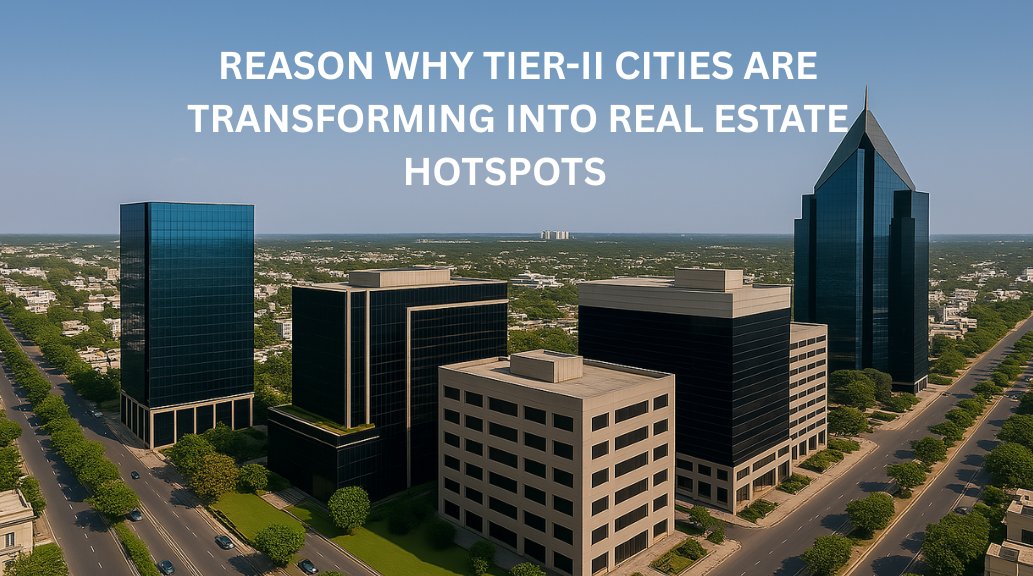
India’s Tier-II cities are quickly gaining attention as the next big commercial real estate hubs. As office leasing demand moves beyond traditional metro cities like Bengaluru, Mumbai, and Delhi-NCR, smaller cities such as Coimbatore, Mysuru, and Bhubaneswar are rising as new growth engines for businesses.
What’s Driving the Boom?
According to real estate experts, this shift is powered by several key factors :
- Skilled Talent Pool: Tier-II cities have a strong base of educated professionals, especially in tech and IT services.
- Cost Advantage: Office leasing and operational expenses are 30–50% lower than in metros.
- Hybrid Work Models: The acceptance of remote and hybrid work has encouraged companies to adopt the hub-and-spoke model, opening satellite offices in smaller, cost-effective locations.
- Government Support: Pro-business policy frameworks are encouraging corporate expansion in these regions.
“Tier II cities are witnessing increased demand due to evolving work models, talent availability, cost benefits, and better policies,” said Vimal Nadar, National Director and Head of Research at Colliers India.
Real Estate Growth in Numbers
Data from Propstack reveals that multinational companies have leased over 10.87 lakh sq ft of office space in Coimbatore alone in recent years, with lease deals totaling approximately ₹402.26 crore.
Some major transactions include :
- State Street Corporate Services – 2.1 lakh sq ft for ₹126.24 crore
- Bosch Global Software Technologies – 3.25 lakh sq ft (₹98.99 crore)
- Infosys – 2.56 lakh sq ft (₹79.8 crore)
- Cameron Manufacturing India – 98,726 sq ft (₹35.66 crore)
- Accenture – 90,008 sq ft (₹27 crore)
- Deloitte Shared Services – 54,666 sq ft (₹25.39 crore)
- Amazon Development Centre – 51,000 sq ft (₹9.18 crore)
Nadar noted that nearly 50% of India’s startups now originate from Tier II and III cities, many in the IT and tech sectors, driving up the need for high-quality (Grade A) office spaces.
Rise of Flexible Workspaces
The MyBranch-Qdesq report found that demand for flexible office spaces in Tier-II and Tier-III cities grew 12% annually in 2024, while supply increased fourfold between 2020 and 2024. The boom in co-working spaces reflects the growing need for cost-effective and adaptable office solutions.
Key Emerging Hubs
Several Tier-II cities are already becoming mini-commercial ecosystems :
- MIHAN – Nagpur
- Mahindra World City – Jaipur
- Infopark & SmartCity – Kochi
- Technopark – Trivandrum
- InfoCity – Bhubaneswar
- STPI – Dehradun
Newer hotspots like Lucknow’s IT City, Vizag’s Fintech Valley, and Coimbatore’s TIDEL Park are also gaining traction.
In cities like Coimbatore, average rent in CBD areas ranged between ₹50–70 per sq ft in 2024. In Kochi, Indore, and Vizag, office rents averaged between ₹40–60 per sq ft, depending on the location and property grade.
Work-Life Balance & Affordability
The pandemic-induced reverse migration played a big role in boosting Tier-II cities. Professionals moved back to non-metro hometowns, seeking a safer, more affordable lifestyle—without compromising on career growth. The shift was supported by remote working and co-working setups.
Real estate expert Shrinivas Rao of Vestian added, “These cities offer ample land, local talent, and substantial cost savings. In 2024, Tier-2 cities saw an 11% rise in hiring—Kochi, Coimbatore, and Jaipur were among the top spots.”
Challenges Ahead
Despite promising growth, experts warn of a few hurdles :
- Limited stock of Grade A spaces
- Inconsistent urban infrastructure
- Poor internet bandwidth in some areas
- Lack of reliable public transport and healthcare services
“Developers must focus on quality and timely delivery to sustain growth,” Nadar noted. Efforts like the National Broadband Mission 2.0 aim to address digital infrastructure gaps in these cities.
Conclusion
Tier-II and Tier-III cities in India are no longer just affordable alternatives—they’re becoming strategic hubs for commercial growth, especially for IT, startups, and flexible workspace providers. As infrastructure improves and policy support continues, these cities are expected to complement Tier-I markets and lead the next wave of real estate development.
Knowledge Source : https://www.hindustantimes.com/real-estate/beyond-the-metros-why-are-tier-ii-cities-emerging-as-the-new-commercial-real-estate-hotspots-101748363053090.html